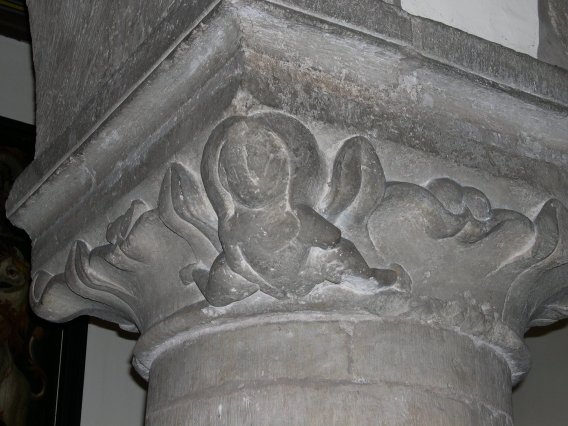
This figure can be found atop a capital in the Church of St Helena in the small village of Austerfield in Yorkshire. a lot of the original masonry can still be seen. The church has strong connections with the pilgrim fathers. The governor of the community which sailed on the Mayflower, William Bradford was baptised in this church on the 19th of March 1589.
A Hidden Sheela
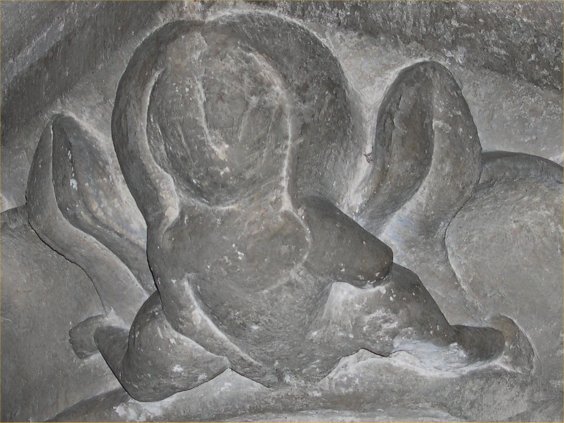
The figure is large and more crudely carved than the other carvings in the church. The face is missing, has weathered away or more likely, has been defaced at some time. A number of scratches on the face seem to lend weight to this interpretation. However the it may be that the figure never had a face as the proportions of the head seem reasonable and there is no indication of the mouth. The figure appears to be wearing a headdress or has a full head of hair. The right hand gestures to the groin where a fairly modest vulva is indicated by a cleft. The left arm is truncated at the elbow. A raised area on the chest may indicate breasts but there appears to be no space indicating clevage. The figure has spent most of the last 500 years or so hidden in a wall. The norman pillar, on which the sheela resides, was walled up with its neighbours possibly in the 14th century when the North aisle of the church collapsed. Rather than rebuild the aisle the pillars were filled in and replastered to make the outer wall of the church. During the 1898 restoration of the church the pillars were rediscovered and uncovered. Fortunately parts of the capitals protruded from the wall which alerted the architect of the restoration that there might be something within the wall.
The Church and the Bullies
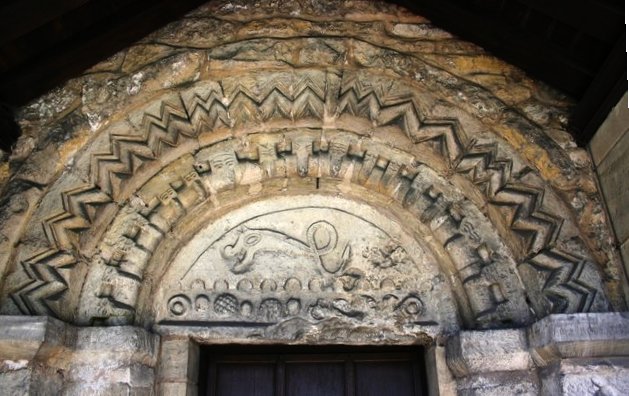
The church leaflet states that the present church was built in 1080 by John de Bully (alternate spellings are Busili, Buslim Buesli and Buili) as a Chapel of Ease for the people of Austerfield. They had previously had been making a 12 mile round trip every Sunday to attend Blythe Priory. John de Bully lived from 1054 to 1089 (?), since the church would have built between these dates or soon after, it places the carving of the sheela firmly in a Norman context but one which is quite early for a UK sheela na gig. This of course assumes that the sheela was carved at the time of building. Even if the sheela is a later addition the pillars are still Norman work (12th century?). Whichever century the pillars belong to it still firmly places the figure in a Norman context. The church is also famous for its tympanumover the south door which shows a fairly crude dragon. An article by the Rev Edward Dunnicliffe in the Southwell review of 1954 places the dragon tympanum in the 8th Century and relates it to the Synod of Austerfield of 702 which settled the manner in which the date of Easter should be calculated. However an article on the CRSBI site (below) seems to imply that the tympanum is the work of the Yorkshire school of Romanesque sculpture rather than earlier Saxon work.
Austerfield is approximately 5 miles to the east of Tickhill Castle which houses some possible exhibitionist figures and was owned by Roger de Bully who is renowned “for being famous in the Domesday book and nowhere else”. So once again we seem to have a local tradition of carving exhibitionist figures and the same family acting as patrons.
There is a fairly detailed page on St Helena’s at Doncaster Family History Society websitehttp://www.doncasterfhs.co.uk/churches/austerfield.htm
No mention is made of the sheela na gig.
An article on Romanesque sculpture in the West Riding of Yorkshire can be found here
http://www.crsbi.ac.uk/crsbi/ywpreface.html
Thanks go to Chris Harrison for supplying the images and the church leaflet
John Harding