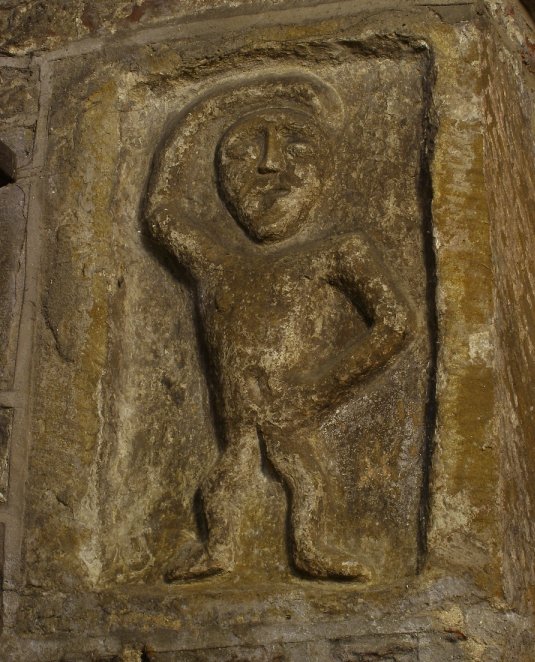
The Croft on Tees Sheela resides in the Church of St Peter on the banks of the river Tees.
The Hard to Find Figure
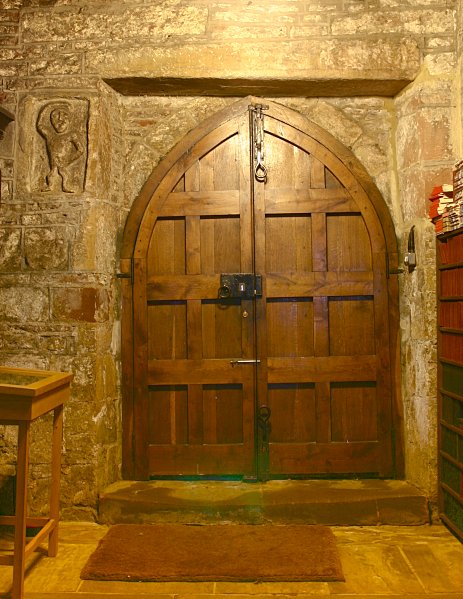
For some reason I spent a long time looking for this sheela despite the fact it is about 2 ft high 1 and half ft wide and right next to the main door. If my friend hadn’t pointed it out I would have walked right past it. As you can see from the pictures it’s quite large and is at head height. Its hard to tell if the sheela was originally moved from somewhere else because the pointing on the walls looks very recent. The stone does seem to fit very well into the door frame although there are smaller stones behind it. It may well be in situ but it is impossible to tell whether or not it’s been moved from somewhere else (Local legends would suggest this is the case, see below). The carving is quite crude and considerably differs from the rest of the carving in the church . The carving has a small deeply incised slit for a vagina which is quite narrow and not immediately obvious. There are the remains of a saxon cross in the church which would seem to indicate that the site has had religious connections for quite some time. When I first visited the figure no mention was made of the sheela in the documentation. Apparently this is not the case as of April 2005 where the figure is described as male???
Male or Female?
The church guide and a number of websites describe this figure “Romano British” and as being male. The evidence for the figure being male is due to damage around the navel of the figure which can be seen in the photograph. No mention is made of the nipples or breasts on the figure which also can be seen in the photograph. Given that the figure has a deep if narrow cleft between the legs which extends up into the body I find the description of the figure as being male a little odd as it has no discernable male characteristics and is very smiliar in features to other sheela na gigs.
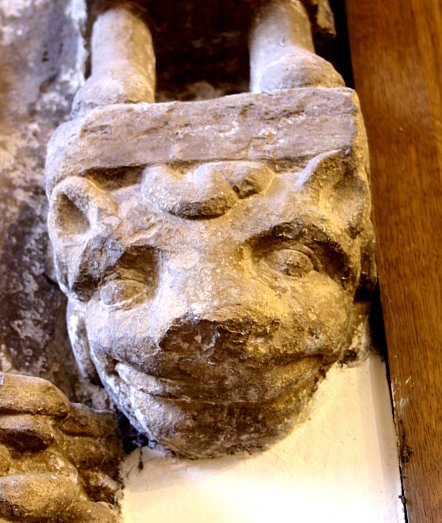
The church’s main claim to fame is that Lewis Carroll’s father was the rector there while Lewis was growing up. Both his mother and father are buried in the church yard. The church also has a carving of a grinning cat’s head which from some leaflets in the church is supposed to be the original Cheshire cat. (See below)
Folkore
Updated Feb 2002
Thanks to John Leech who got in touch with the following information on the figure:
“In the late 60’s Rev Littleton used to show the children of the school round the church and tell us loads of things about it. An interesting church with its two family pews, thought to have sprung up as a place of worship for the ford across the Tees of yesteryear. We were told that the carving was an ancient water god that people consulted before braving the water. Well… we were all kids.”
Interestingly the book Twilight of the Celtic Gods also relates this tradition that the figure originally resided on a bridge and was “a local deity of the sea”.
Hard to photograph
There is a tradition that this sheela is very hard to photograph and people have come away with no usable prints. Jorgen Andersen reported this and a newspaper article on the same subject is mentioned in “Twilight of the Celtic Gods” in a chapter entitled “The Curse of the Sheelas”. I was completely unaware of this at the time and happily snapped away coming away with some nice images. I’ve since been contacted by someone who reported the same problem while photographing the figure. He put it down to technical difficulties (which he failed to elaborate on) rather than any supernatural reasons which are hinted at in “Twilight of the Celtic Gods”. Interestingly people with digital cameras don’t seem to have any problems. I would be interested to hear from anyone who has had difficulties in photographing this sheela as the stories surrounding seem to be piece of folklore in the making.
Update Sep 2004
I’ve since been contacted by an American lady, Robin Powers who has travelled around photographing most of the British sheelas. She didn’t have any problems photographing it either and used a film camera. It would definitely seem that these “you cant photograph it” stories are definitely a bit of folklore in the making based on a few failures to photograph a figure in difficult lighting.
Update Dec 2006
I recently visited the figure again and managed to take some higher quality photographs (again with very little trouble). I also took a closer look at the carvings on the sedilla near the altar. The sedilla is of a later date but has some rather odd carvings above the arches including what appears to be a beakhead. There are also a number of other carvings in or on the church including two Saxon cross fragments and some faint allegedly Roman carving set into the church wall.
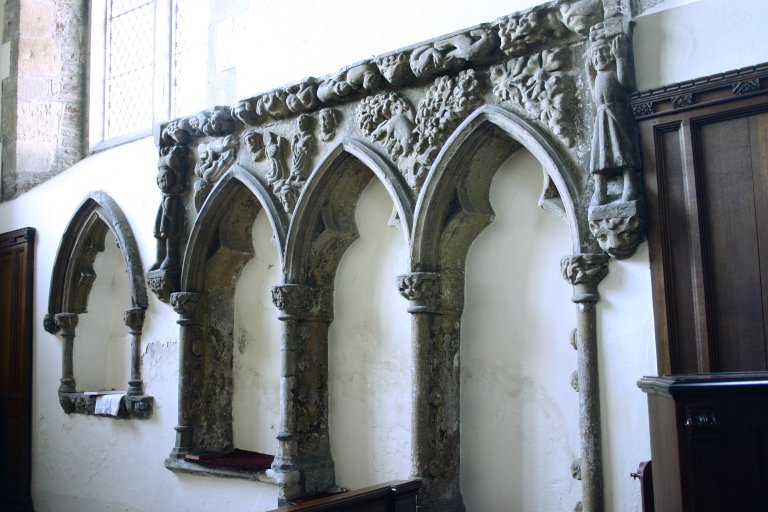
The sedilla at the church has a number of later carvings, the meanings of which are not immediately obvious. They include a fighting couple, grimacing men, animals and what appears to be a beakhead. The Cheshire Cat carving can be seen on the right of the picture under the grimacing man.