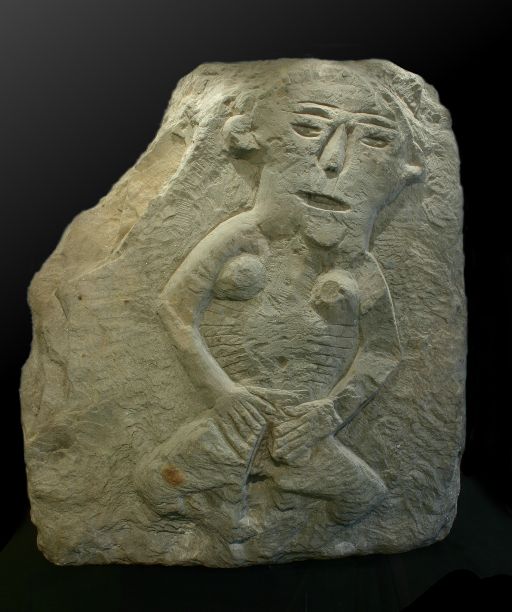
The Figure
Location: ///removes.viewer.chitchat Inside museum.
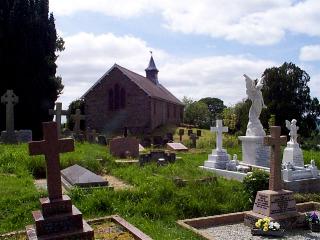
The Llandrindod Wells sheela is one of best preserved, probably due to the fact that it has spent the greater portion of it’s life buried face down in the wall of the local parish church . (For another figure that was buried face down see Braunston) Despite the church being a fairly modern construction its is still known as the Old church and lies almost 1000 ft above sea level. The first mention of the church in documents is in 1291 and it is built on what appears to be a natural mound. When I visited the church I asked an old lady in the churchyard if she knew anything about the figure. She replied that it had been found face down in the place where the coal was kept to heat the church.
The sheela has been moved recently to the Radnorshire Museum on long term loan apparently for security reasons. The address is listed below.
Radnorshire Museum,
Temple Street,
Llandrindod Wells,
POWYS
LD1 6BA
Tel: 01597 824513
Fax: 01597 825781
This is one of the few sheelas in Wales the only others being in Penmon, Anglesey far to the North and two possible sheelas in the Camarthen and Ceredigion museums . The carving is crude but the lines are sharply delineated. The vulva is deeply incised and ribs can be seen either side of the torso, the freshness of the carving is remarkable given its age.
Email: radnorshire.museum@powys.gov.uk
Musem Website http://www.powys.gov.uk/index.php?id=2118&L=0
As you can see from the photo below above the sheela was originally kept in a window in the local church it is quite large being over two foot high.
Connections with the Herefordshire School of Sculpture.
The Llandrindod sheela is a loose piece of sculpture no longer in its original setting and such is hard to date. The style of the carving is crude which could indicate a date anywhere from the dark ages to the late medieval. The church in which the figure was found is first mentioned in church documents in the 13th century. However there is some evidence which seems to suggest a romanesque date for the carving sometime during the 12th century. The church of Llanbadarn Fawr a few miles to the north of Llandrindod Wells holds a broken figure, also recorded as a sheela na gig, which bears some similarities to this figure in style. The breasts on both figures are an unusual truncated cone, both are quite large and both feature ribs. It would seem likely that both figures share the same influences or even the same sculptor. The carving at Llanbadarn Fawr is placed firmly in a Romanesque context along with a carved door and tympanum that Malcolm Thurlby suggests shows Herefordshire School influence.
It is interesting that this figure, the only unequivocal sheela in Wales, should have a link with the school that carved Kilpeck however slight. There is also a corbel at the museum from Cwm Hir Abbey which shows distinct Romanesque features. Given both the nearby church and St Padarn and Cwm Hir abbey there seem to be plenty of potential Romanesque sources for the sheela even if it did not originally come from the church where it was found.
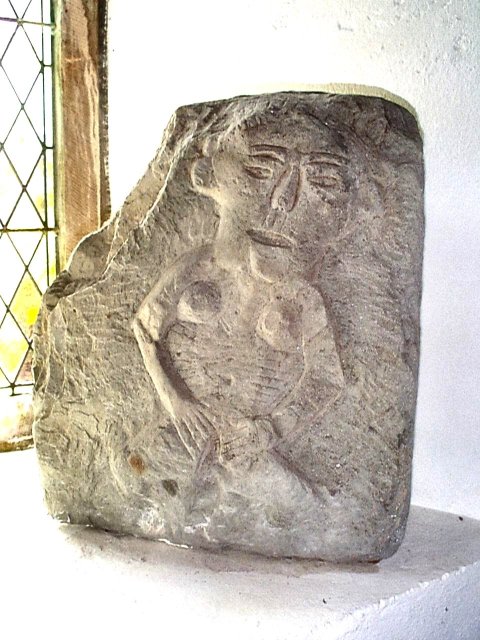
The sheela in the window of the local church circa 1999.
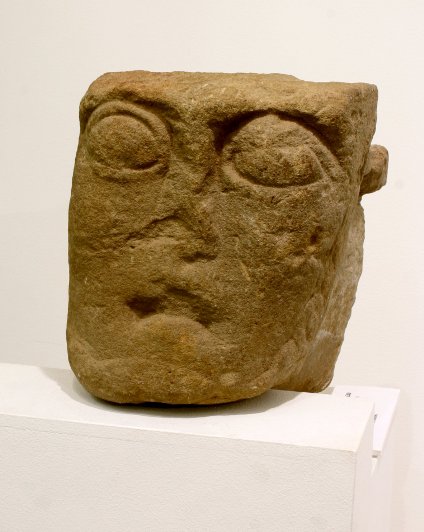
The Romanesque head found at Ty Faenor is thought to have originally been a corbel from the Abbey of Cwmhir (Abatty Cwmhir) one mile distant. The head shows classic Romanesque features though the accompanying sign at the museum says its shows celtic influence.
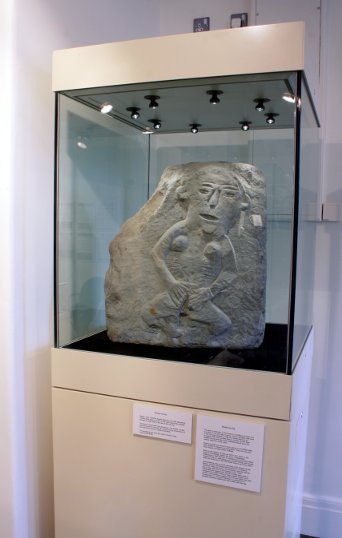
The Sheela in its case at the museum. Probably one of the best looked after sheela’s in the world.