The Figures
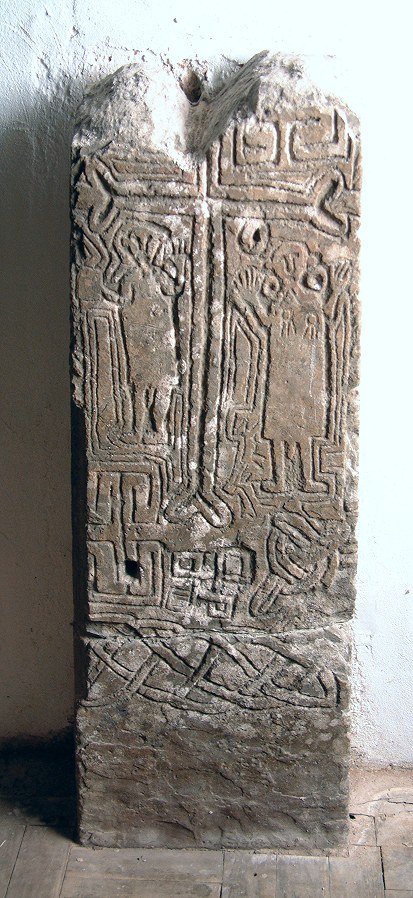
Llanhamlach is a small village approximately 4 miles to the east of Brecon in Powys S.Wales. The church of St.Peter in the village contains the Ioannis Moridic stone pictured on the left. It is thought to be no later than the 11th century and there is also some conjecture that the stone that it could be two or three centuries earlier. There is a latin inscription on the right hand edge which reads IOHANNIS / MORIDIC SUREXIT HUNC LAPIDEM which is thought to mean “Moridic erected this stone”. There is a marked space and slash between the IOHANNIS and MORIDIC. According to a sign on the church SUREXIT is thought to be an error on the part of the sculptor who had an incomplete grasp of Latin. The IOHANNIS is thought to be part of another inscription which is now lost. What is most intriguing about the stone is the two figures carved either side of the decapitated cross. Both appear to have “penises” peeking from beneath their garments yet the right hand figure also appears to have breasts with “rays” emanating from them possibly indicating milk. Both figures hold their hands in the air and the right hand figure also appears to have “earrings” i.e. circles either side of the head. The stone appears in the 1876 book “Lapidarium Walliae” by J.O. Westwood who identifies the figures as Adam and Eve under the tree of knowledge and the Virgin Mary and St John standing beside the cross in turn. Interestingly no mention is made of the possible “penises” and the illustration in the book omits them altogether. Another example of the Victorian bowdlerisation of carvings which also happened to the Kilpeck figure.
You may also want to compare the carvings on this stone with the Three Disgraces at Burford church. The middle figure is carved in a similar manner with a “penis” peeking from beneath a shift. It’s very hard to say what this stone is meant to represent with it’s confusion of sexual symbolism.