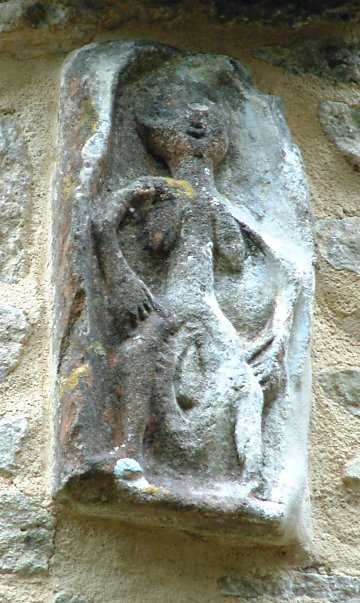
The Oaksey Sheela Na Gig
The small village of Oaksey lies in Wiltshire some 8 miles South West of Cirencester. It is called Wochesie in the Domesday book but is also called Occhesei and Wokesey ,Woxy and Wrockeseye
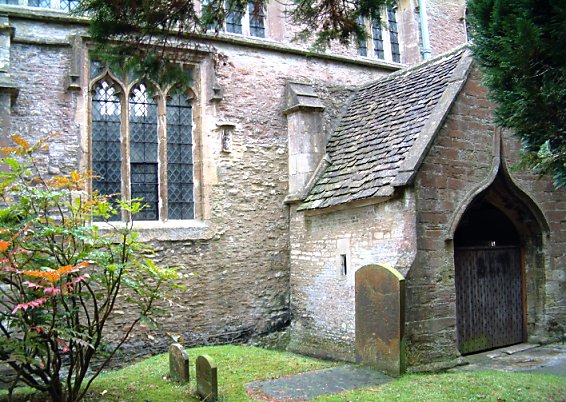
This sheela can be found on the north wall of the Parish Church of Oaksey Wiltshire. On my first visit to the church my camera decided to lose most of the pictures (The curse of the sheelas strikes again?). The sheela can been seen just to right of the window about half way up.The Oaksey Sheela Na Gig
This sheela is quite shocking in the explicit and exaggerated carving of the vagina even including the clitoral hood. The vagina as you can see from the photograph is incredibly exaggerated. Half of the head has broken off yet the rest of the carving is in pretty good condition. Inside the church there are a number of medieval wall paintings .There is an Irish story, “Da Derga’s Hostel” where a hag’s pudenda hangs to her knees. This could almost be a description of this carving. The figures right hand rests on the the thigh and it looks like a finger points to the exposed vulva. This pointing motif can be found in other figures including Lower Swell and the now destroyed Buncton figure.
I recently revisited the church to find that some efforts have been made to conserve the carving by placing a lead roof above it (left). It looks like some effort has been made to clean the carving and the surrounding masonry has been re-pointed. It’s interesting to note that the carving is being looked after even in our modern times and is obviously held in some respect or at least is considered to be worth saving.
A Romanesque connection
No mention is made of a church in the Domesday book and the current church, dedicated to all saints, is thought to go back to the middle of the 13th century. Its architecture contains elements of the early English and Perpendicular styles. The sheela na gig motif however seems to originate from the 12th century especially those with exaggerated genitals like the Oaksey example. So does this make the sheela a later example of the motif? There is some tantalising evidence that suggests an earlier Norman or Romanesque phase of the church which is now less evident,John Britton in his “Topographical Sketches of North Wiltshire” in 1826, wrote that the nave and chancel were separated by a massive semi-circular arch. Given that the Early English period (the period directly following the Romanesque) is distinguished by its pointed rather than round arches, the existence of the round arch would seem to indicate an earlier Romanesque incarnation of the church. It would be interesting to see if any other evidence of this incarnation is still present in the church. Further evidence for Norman activity in the village lies in the remains of Norwood Castle, a motte and bailey construction to the North West of the church. In 1870-72, John Marius Wilson’s Imperial Gazetteer of England and Wales wrote the following “The church is partly Norman; was recently restored; has some stained windows, and an embattled tower”. This seems indicate that the round arch fell victim to Victorian “improvement” and was possibly replaced some time before 1872 with the current Victorian Gothic arch that we see today. Given that the round arch points to an older Romanesque phase of the church, then it would make more sense to attribute the sheela to that period rather than the later ones. If this is the case then it seems that the figure was regarded as worth saving and including in the modifications made to the church down the years.
Gallipot Eyes
The figure is briefly mentioned in the book Gallipot Eyes by The Flame Trees of Thika author Elspeth Huxley who lived in the village for a number of years. Bizarrely the figure is referred to as male!