The Figures
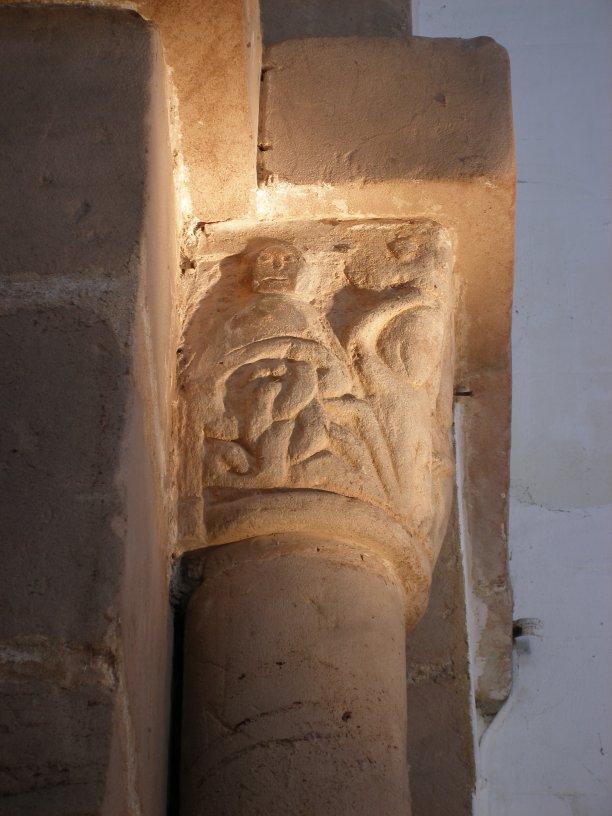
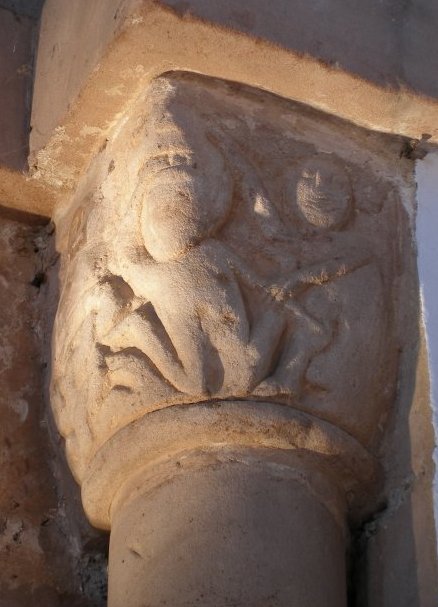
These figures lie in the church of St Margaret in Wolston near Coventry. The figures in question are carved on a capital on the west side of the crossing arch (the arch facing the congregation). The figures consist of a female splay legged figure with a deep wide cleft in the groin area. The cleft also seems to contain the remains of a smaller oval within it. Its arm is being pulled by a less defined figure on the right. When viewing the figure in the church the splay legged figure appears to have a massively oversized head with the eyes at the top. As we can see from the photographs this is not the case. Directly above the female’s head is a monstrous corner mask which appears to be eating the the figure below. The right hand figure (sexless but vaguely male) touches this mask with its right hand. The female figure appears to have a head of hair and the right hand is placed on top of the head seemingly in the mouth of the mask. There seem to be the faint remains of a face on the figure. The female figure’s left arm appears to be holding the groin of the right hand figure or at least is resting its hand on the top of the leg. The left hand side of the capital holds the upper torso of a figure with lower half consisting of some fairly crude knotwork or vegetation. The sheela’s leg disappears into this knotwork.
The left hand capital opposite is damaged but consists of two figures either side of a cross possibly depicting the crucifixion.
A damaged sheela?
As can be seen from the photograph on the right, the cleft between the legs is wide and uneven. The smaller oval shadow is a result of the lighting but there does seem be a slightly deeper more regular oval within the wider cleft. Given the quality of the carving it may be simply that this wide cleft is the sculptor’s execution of a vulva. However it is equally as likely that at some point the figure has been damaged and the cleft widened. The damage however may not be intentional. Church records show that the tower collapsed in the 1700s so the damage to this and the other capital may be a result of this collapse. The church history also mentions that the arches may have been reconstructed at this time.1
Brandon Castle
Visible from the church yard are the remains of a Norman motte known as Brandon Castle. Brandon being the neighboring village. Hubert Baldran granted the church to the abbey of St. Pierre-sur-Dives between 1086 and 10941 and the Verdon family held Wolston during the 12th century. The castle is known to have been garrisoned in 1195. Excavations done in the 1940s suggest that the keep was rectangular. There is no evidence to suggest what the keep looked like but it is thought to be similar in design to Hopton Castle in Shropshire, much of which stands today. Once again we have an exhibitionist in a church which is intimately connected with a stronghold of the local lord. i.e. the church would have been the personal chapel of the local lord. This is similar to Kilpeck, Holdgate, Devizes and possibly Bredwardine in Shropshire.
1 CRSBI page on Wolston accessed 21/10/2006 http://www.crsbi.ac.uk
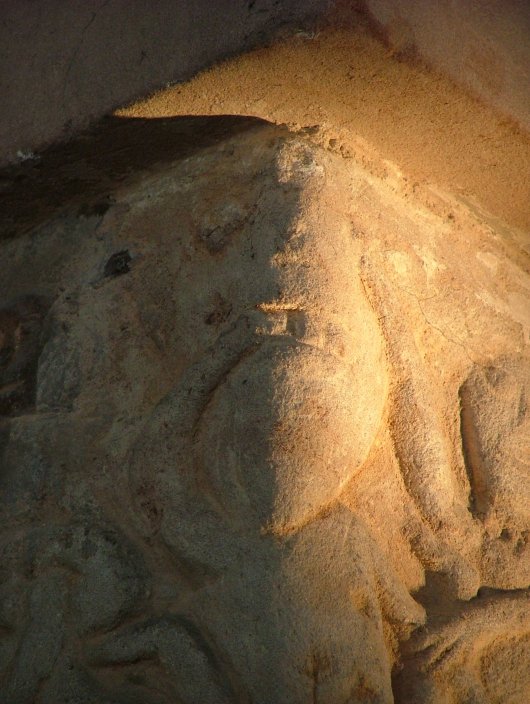
Note the faint suggestion of eyes on the sheela’s head and what appears to be hair on the left hand side.